

Conversion rate optimization (CRO) is experimentation.
Every CRO specialist is continuously conducting tests and investigations. The proper organization of tests based on research is essential here. During the research process, much attention is often given to the “what” and “how.” What happens in the data, and how can we improve it? However, the “why” is just as important. With insight into consumer behavior, your tests become more effective, and you increase the success rate of the conversion optimization.
User Experience (UX) tests popular among CRO specialists.
CXL, a data-driven growth and conversion optimization agency from Texas, conducted a study in 2018 in collaboration with VWO, a software company from New Delhi that helps organizations with visitor research (conversionxl.com). They asked 701 people working in digital optimization 26 questions and processed the results in a report. The study shows that, in addition to test methods aimed at digital analytics and A / B testing, the respondents experience research to improve UX as useful (top 3). One reason is that a seamless UX makes it easy for users to achieve their goals, such as placing an order or finding information. A seamless UX allows you to attain customer-oriented optimization sustainably.

The more tests, the better?
The research also shows that establishing a fair CRO process is considered the most significant challenge – especially finding the right tools and determining the purpose for which they are used. Although the respondents attach great value to UX research, they find it difficult to prove an improved ROI with UX research. UX studies are often user tests, in which interview reports are made. These studies take time and provide qualitative insights that are not based on hard data. The lack of hard data makes it difficult to convince stakeholders of the added value. Calculating an ROI on the effect of A / B testing, on the other hand, is a straightforward calculation. That is why many CRO specialists equate the success of A / B testing with the “velocity” of testing (speed and amount of tests). The more tests you perform and the faster you do this, the more likely a test will win. In general, the success rate demonstrates the value of A / B testing.
The importance of a structured testing strategy.
Obsessing over the velocity of testing will not deliver the long-term success that one has been hoping for. The key to sustainable test output is finding a balance between short term (velocity) and long term (research for data collection and insights). When you focus exclusively on velocity, there is less time for structuring the tests. You miss out on wisdom.
Another problem is that when testing many ideas quickly, the ability to validate and use a test properly is sacrificed. A winning A / B test may mean a quick conversion, but that doesn’t always mean that the full potential of that idea has been explored. You are drawing up a massive list of experiments without really understanding the “why” for a particular data finding can lead to more hail shooting with your testing ideas than if you were fact-based and practical. Even though you can make a lot of “noise” internally with a “test as much as possible” strategy, your success rate is what counts. And don’t we all want to achieve the most incredible possible result with as little effort as possible?
More success in conversion optimization thanks to emotion data.
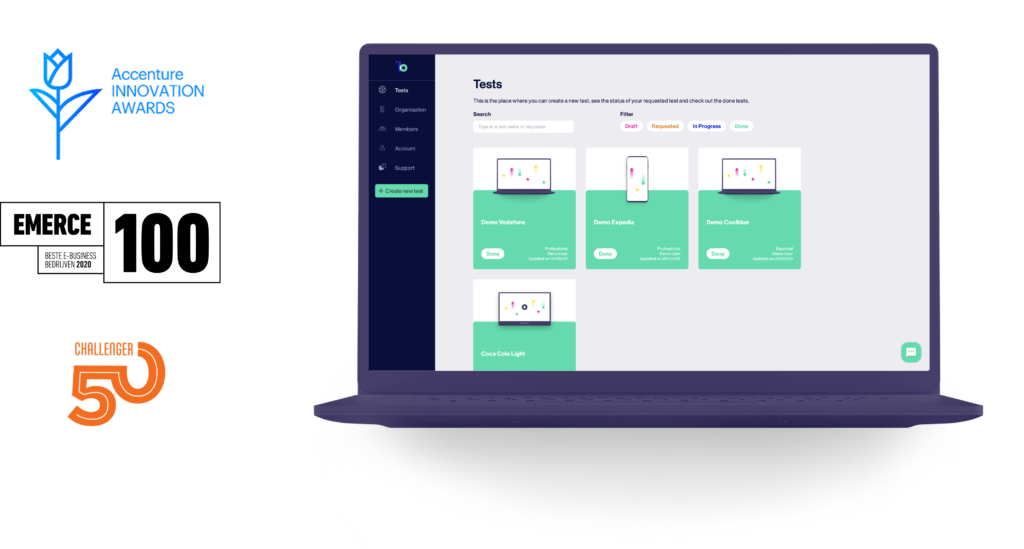
As indicated earlier, regular UX studies often do not provide data-driven insights. Therefore, it is challenging to demonstrate within an organization that these insights contribute to business growth. That is why Braingineers uses objectively measured emotion data in user research to indicate precisely where optimization opportunities lie. By combining neuroscience with artificial intelligence, we detect emotions among consumers based on brain data. They notice the feelings and simultaneously capture eye tracking, mouse tracking, and screen recordings. This way, you can see second-by-second how your users interact online and what they are unconsciously experiencing at that moment. Braingineers also collect regular user feedback with the emotions experienced as a reference. We make this information accessible to the entire team in the emotion analytics platform: Brainpeek.
With Brainpeek, it is, therefore, possible to continuously conduct data-driven UX user research. UX data thus forms a fundamental basis for hypotheses. You can objectively indicate which points in the journey users experienced frustration, for example, why this is, what their expectations were, and why their expectations did not match their experiences. With these insights, you can form hypotheses and prioritize and create them in A / B testing. This way, you no longer shoot with hail, and each test delivers real business growth.
This post was made in collaboration with Braingineers. If you have any questions about the solution of Braingineers, Brainpeek, or if you want to discuss anything, do not hesitate to send them a message.